
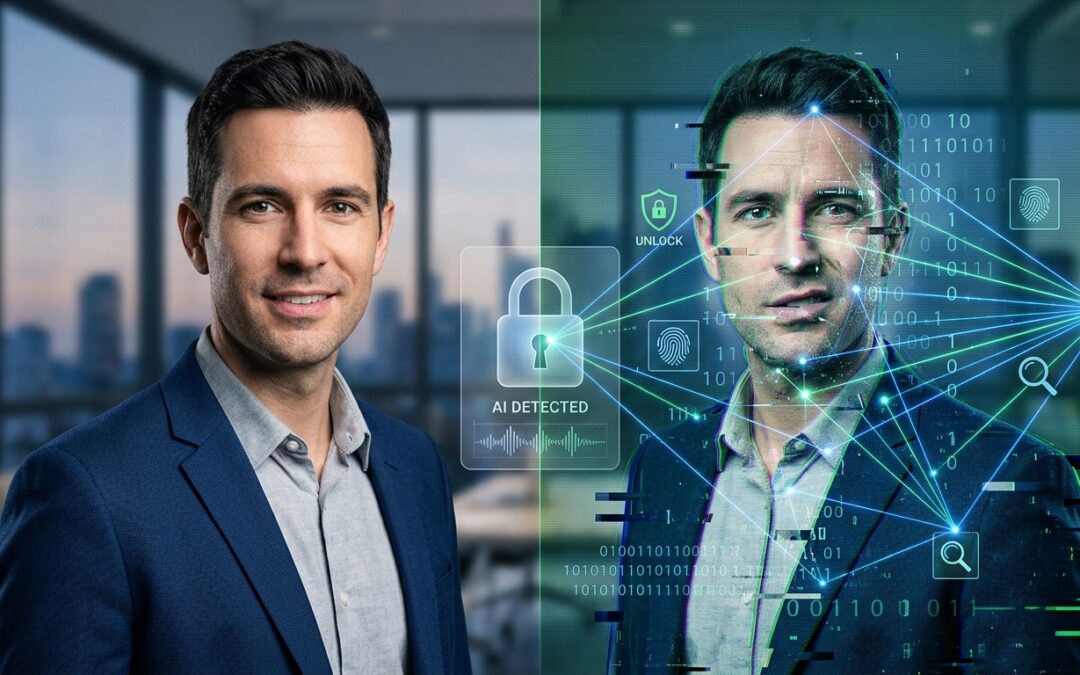
Just a few seconds of voice sampling or a photo taken from a social media profile is enough to allow artificial intelligence algorithms to recreate a person's voice or face in an unsettling and realistic way. Today, security against deepfakes has become an absolute priority for citizens, businesses, and institutions, as fraudsters use these digital clones to carry out extortions, banking scams, and advanced disinformation operations.
How technology clones reality
To understand how these manipulated contents are created without getting lost in the details of theoretical computer science, just imagine two algorithms playing cops and robbers: one creates the fake and the other tries to spot it until the copy becomes indistinguishable from the original. In the first paragraph of this guide, the main challenge clearly emerges: the spread of security against deepfakes must contend with software tools that are increasingly cheap and accessible to anyone, capable of simulating real-time phone calls or video calls by replacing face and voice with extreme precision.
Technologies and strategies for security against deepfakes
To defend against these threats, cybersecurity research is developing diagnostic analysis tools capable of spotting imperfections invisible to the human eye and ear. Ensuring effective security against deepfakes means employing software that analyzes blink frequency, facial muscle micro-movements, fluctuations in retinal light reflections, or anomalies in audio frequencies. At the same time, many platforms are integrating digital watermarking systems to track the authentic origin of multimedia content.
Poliphonic Forensic: Advanced Audio Analysis to Support Truth
To effectively tackle this technological challenge, Drive2Data has developed Poliphonic Forensic, a cutting-edge project born from the need to enhance audiometric analyses on audio streams and certify their results using Data Intelligence Learning algorithms and neural data models.
Our system integrates artificial intelligence to recognize a voice with extreme precision by comparing it in real time against a classified neural model. The model is trained on the specific characteristics of the training samples: as little as two minutes of audio recording is enough to develop the subjects' so-called "voiceprint". This technology also makes it possible to verify the calibration of the voice recognition system, generating accompanying graphs and evidentiary documentation, thus becoming a crucial tool for the benefit of forensic, legal, and corporate fields.
Best practices and awareness for the future
Beyond software solutions, protection against these scams requires a mindset shift in the daily use of technology. Combining user training with technologies for security against deepfakes creates a fundamental first shield: establishing familiar passwords to verify identity over the phone, always double-checking unusual money requests through alternative channels, and avoiding sharing sensitive data upon first contact. Only by combining technological innovation with a solid culture of caution can we protect our identity and savings in the age of AI.
MORE TO EXPLORE...
Natural Language Processing: Tasks, Applications and Sentiment Analysis
The human-machine dialogue has been one of the most active areas of research for decades. In recent years, great progress has been made in the field of NLP (Natural Language Processing), although, due to the complexity of human language, the machine is not yet able to understand perfectly... Read more
Chatgpt: a positive revolution if managed correctly
For a few months now, Artificial Intelligence has been making an explosive statement, generating a lot of interest accompanied by doubts, controversies and perplexities.
The wide diffusion of ChatGPT has raised a heated discussion among experts who have focused on understanding the real innovative scope of this intelligent tool. However, the Italian Data Protection Authority has intervened by blocking the use of the data as it does not comply with all the criteria set out in the Data Protection Act...