"If you think you understand quantum mechanics, you don't understand quantum mechanics." — Richard Feynman
Imagine owning the safest vault in the world, protected by a combination that would take a common thief billions of years to guess. Now imagine that, all of a sudden, a thief shows up with a master key capable of opening it in a few seconds. This is the scenario that the cybersecurity world is facing with the advent of quantum computing. To prevent the collapse of our digital infrastructures, scientists and mathematicians are taking action by developing quantum-computer-proof cryptography. This is a new generation of mathematical algorithms designed to lock down our data—from bank transactions to medical records—before the supercomputers of the future become a concrete threat.
From the Enigma Code to silicon: the parallel between anthropological evolution and cybernetic evolution
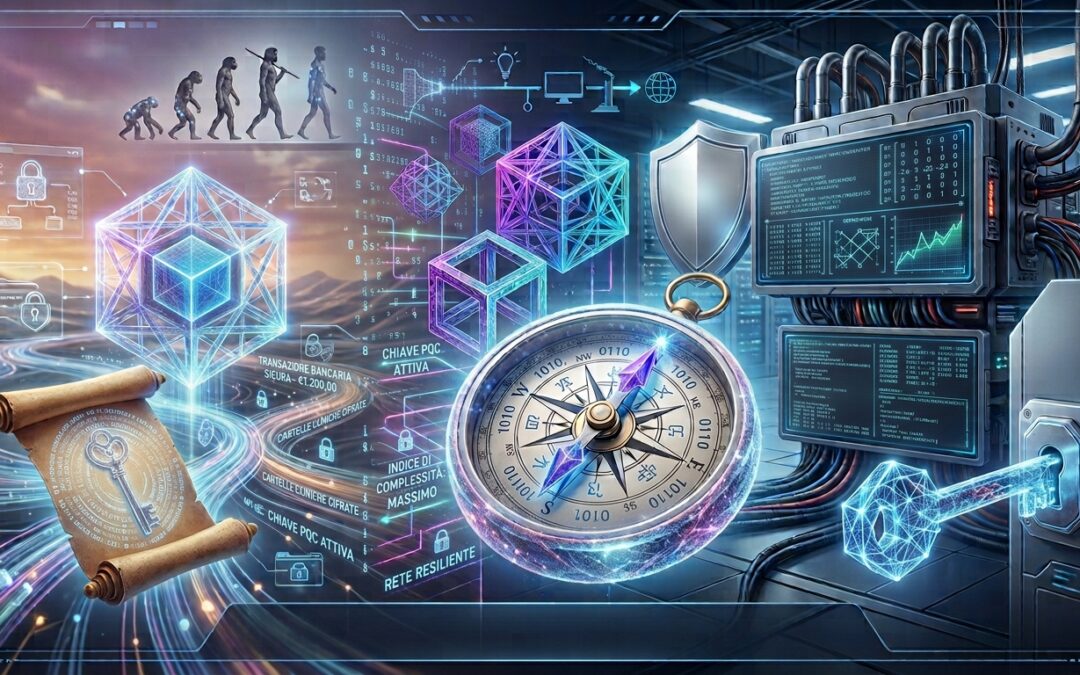
The need to hide vital information has accompanied the history of Homo Sapiens since the invention of writing. Looking at anthropological evolution, secret communication has always been an engine of survival and power: whoever controlled information controlled the territory. During World War II, cybernetic evolution accelerated dramatically precisely to crack the encrypted messages of the German army via the Enigma machine. It was then that the first ancestors of our computers were born.
Today, we are witnessing an identical evolutionary leap, but on an infinitely more complex scale. Cybernetic evolution is pushing us beyond the limits of classical physics. Traditional computers process data as rigid sequences of 0s and 1s (bits), just as primitive humans counted steps or prey. Quantum computers, on the other hand, leverage the bizarre laws of atomic physics to process an infinite number of combinations simultaneously. This anthropological leap in how we manipulate reality requires an equally revolutionary defense: quantum-computer-proof cryptography is our species' new digital shield.
Drive2Data' commitment to tomorrow's data security
In a context where the rules of global cybersecurity are about to be completely rewritten, there is no room for improvisation. At Drive2Data, we have always been at the forefront of technological evolution, supporting companies in managing and protecting their greatest asset: data. For us, looking to the future means not only optimizing current processes, but anticipating tomorrow's risks. Understanding the importance and application of quantum-computer-proof cryptography is part of our strategic vision. Our goal is to guide businesses through this transition, ensuring that corporate information systems remain resilient, secure, and unassailable in the face of any cutting-edge technological evolution.
How quantum-computer-proof cryptography works and why it concerns us all
How do you build a defense against a potentially omnipotent machine? Scientists aren't using brute force, but complex geometry. Quantum-computer-proof cryptography relies on mathematical problems linked to multidimensional structures called "lattices". Solving these puzzles is so difficult that even a quantum computer would get lost in an endless maze.
The most surprising part is that we won't have to wait to have a quantum supercomputer on our desks to benefit from this protection. This new software technology will be invisibly integrated into the browsers, messaging apps, and enterprise systems we use every day. When you update your banking app or send a digitally signed document, a post-quantum algorithm will be working behind the scenes to protect you.
Preventing "Q-Day" for a sustainable digital transition
In the cybersecurity sector, people often speak of "Q-Day"—the day a quantum computer becomes powerful enough to break current encryption systems. Although that day is still several years away, the migration to quantum-computer-proof cryptography must begin now.
Sensitive data stored today could be intercepted now and stored by malicious actors waiting to decrypt it in the future. Timely adoption of this new architecture means protecting not only the present, but also the historical and strategic memory of our organizations, building a digital future that is solid, lasting, and sustainable.
MORE TO EXPLORE...
The Impact of Generative Artificial Intelligence in Data Analysis
In the digital age we live in, Generative Artificial Intelligence and Data Analysis are completely revolutionizing content generation.
This change affects multiple sectors and industries, from commerce to scientific research.

Risk Management and Supplier Analysis
Vendor Risk Management is where Risk Management and Supplier Analysis converge, forming a continuous and multidimensional process. It spans the entire purchasing cycle, from supplier selection to order issuance, including contract execution and potential disposal.
Involving various departments beyond purchasing, such as quality, administration, and logistics, provides a broader perspective, aiding company success.