
"Plants are not immobile objects, but intelligent networks capable of calculating, communicating, and solving complex problems with minimum expenditure of resources." — Stefano Mancuso (plant neurobiologist)
When we think of technological cutting-edge, we often imagine sterile laboratories, metal, and polished silicon. Yet, the greatest IT revolution of recent years is being born from observing forests and ancient herbal knowledge. Scientists and engineers are indeed developing so-called botanically-inspired algorithms. These are mathematical models that no longer imitate the rigid logic of old computers, but copy the behavior of roots, the distribution of nutrients in leaves, and the defense systems of medicinal plants. The goal is to create digital networks capable of self-regulation and self-healing, translating nature's secrets into incredibly efficient software solutions.
From Nature's Pharmacy to Software:
The link between the world of programming and the plant kingdom opens fascinating scenarios regarding the very structure of our communication networks. If we examine the history of computer development, cybernetic evolution initially moved towards centralized and rigid systems, similar to large isolated safes. Today, however, we are witnessing a total decentralization that closely resembles the complex organization of a forest.
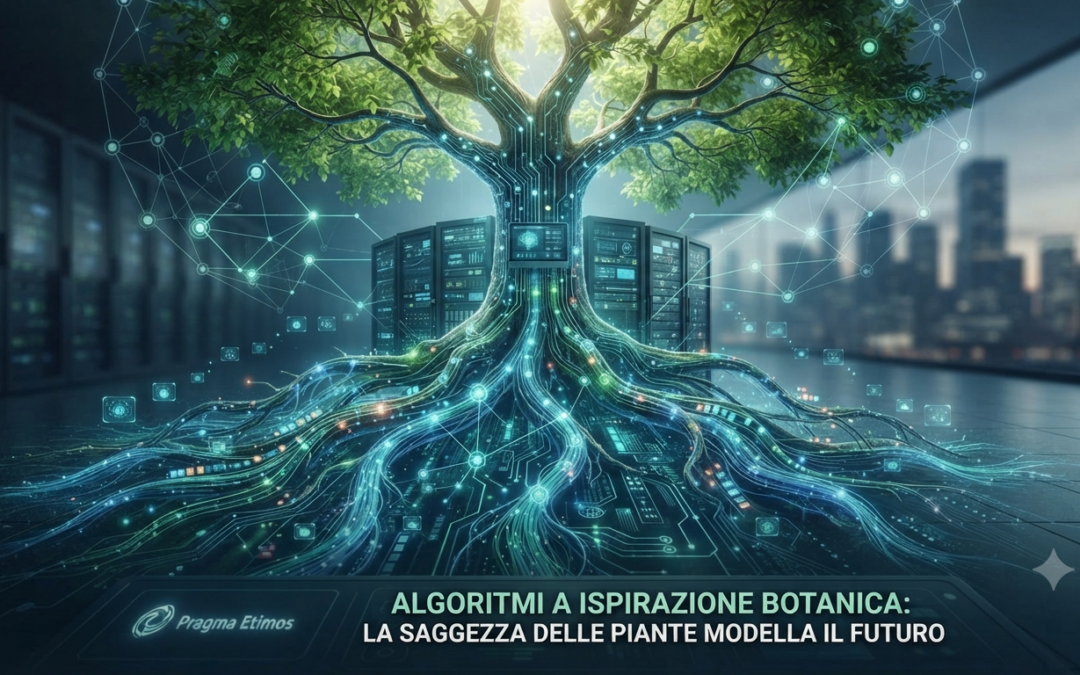
In this paradigm shift, botanically-inspired algorithms represent the perfect meeting point between biological and digital efficiency. Just as a wood has no "central brain" but survives thanks to an underground network of roots and fungi (the so-called Wood Wide Web) capable of exchanging information and resources to support weaker trees, so new IT architectures distribute workloads fluidly, autonomously, and without a single point of structural vulnerability.
Drive2Data' Approach Towards Organic and Structured Innovation
In this transition where IT mimics the flexibility of plant life, knowing how to interpret hidden interconnections is fundamental for the stability of any corporate ecosystem. We at Drive2Data have always been at the forefront of technological evolution, guiding businesses in managing increasingly complex and interdependent information flows. We believe technological development must reflect nature's operational elegance. Studying and integrating logics based on botanically-inspired algorithms allows us to design more resilient data management systems for our partners, capable of adapting to market changes with the same naturalness with which a plant orients its leaves towards sunlight.
How Herbalism and Botany Optimize Information Flows
But how is the study of plants concretely applied to writing code? Think of the veins of a leaf or the growth of roots underground in search of water: they always follow the shortest path with the lowest possible energy consumption. Many network tools use these identical geometric rules to optimize the logic of data routing on the internet, reducing wait times and server wear and tear.
Another fascinating parallel comes from defense strategies studied in herbalism. When a medicinal plant is attacked by a parasite, it produces specific volatile chemical molecules to warn surrounding vegetation, which begins to shield itself in advance. Applying this principle to cybersecurity means creating IT systems capable of detecting an anomaly in a single computer and instantly "secreting" an automatic protection barrier across the entire corporate network, isolating the threat even before human intervention.
Sustainability and Efficiency for a "Green" Technological Future
The acceleration towards botanically-inspired algorithms responds not only to a need for performance, but to a stringent ecological duty. The plant kingdom has dominated the planet for millions of years because it has made energy efficiency its supreme virtue of survival. Conversely, the carbon footprint of our digital infrastructures and data centers continues to grow at worrying rates.
Drawing inspiration from botany allows us to create software solutions that require much less computing power to solve complex problems. From the optimized management of city power grids to industrial predictive maintenance, the convergence between technology and nature is demonstrating that the future of innovation lies not in consuming additional physical resources, but in the ability to replicate the perfect and sustainable balance that plants have always taught us.
MORE TO EXPLORE...

The Impact of Generative Artificial Intelligence in Data Analysis
In the digital age we live in, Generative Artificial Intelligence and Data Analysis are completely revolutionizing content generation.
This change affects multiple sectors and industries, from commerce to scientific research.

Risk Management and Supplier Analysis
Vendor Risk Management is where Risk Management and Supplier Analysis converge, forming a continuous and multidimensional process. It spans the entire purchasing cycle, from supplier selection to order issuance, including contract execution and potential disposal.
Involving various departments beyond purchasing, such as quality, administration, and logistics, provides a broader perspective, aiding company success.